

Dear Clients & Friends,
As we begin a new year together, I want to start by saying how grateful I am for the trust you place in our firm. It is a privilege to serve you — and especially meaningful as we welcome many new families who have joined us in recent months. Whether you’ve been with us for years or are just beginning your journey with us, please know this: everything we do is designed to help you pursue what matters most in your life, with clarity, confidence, and purpose.
I’m happy to report that 2025 was another very successful year in the ongoing pursuit of your most important financial goals. But more importantly, it was a year in which we stayed true to the principles that guide our work — principles that do not change with headlines, forecasts, or market narratives.
Your financial plan — and therefore your investment portfolio — is driven by your goals, not by predictions about the economy or the markets. That will always be the case in the year ahead, and well beyond.
Before offering some perspective on the current economic and market backdrop, I’d like to restate the core beliefs that guide our planning and investment approach.
Our Guiding Principles
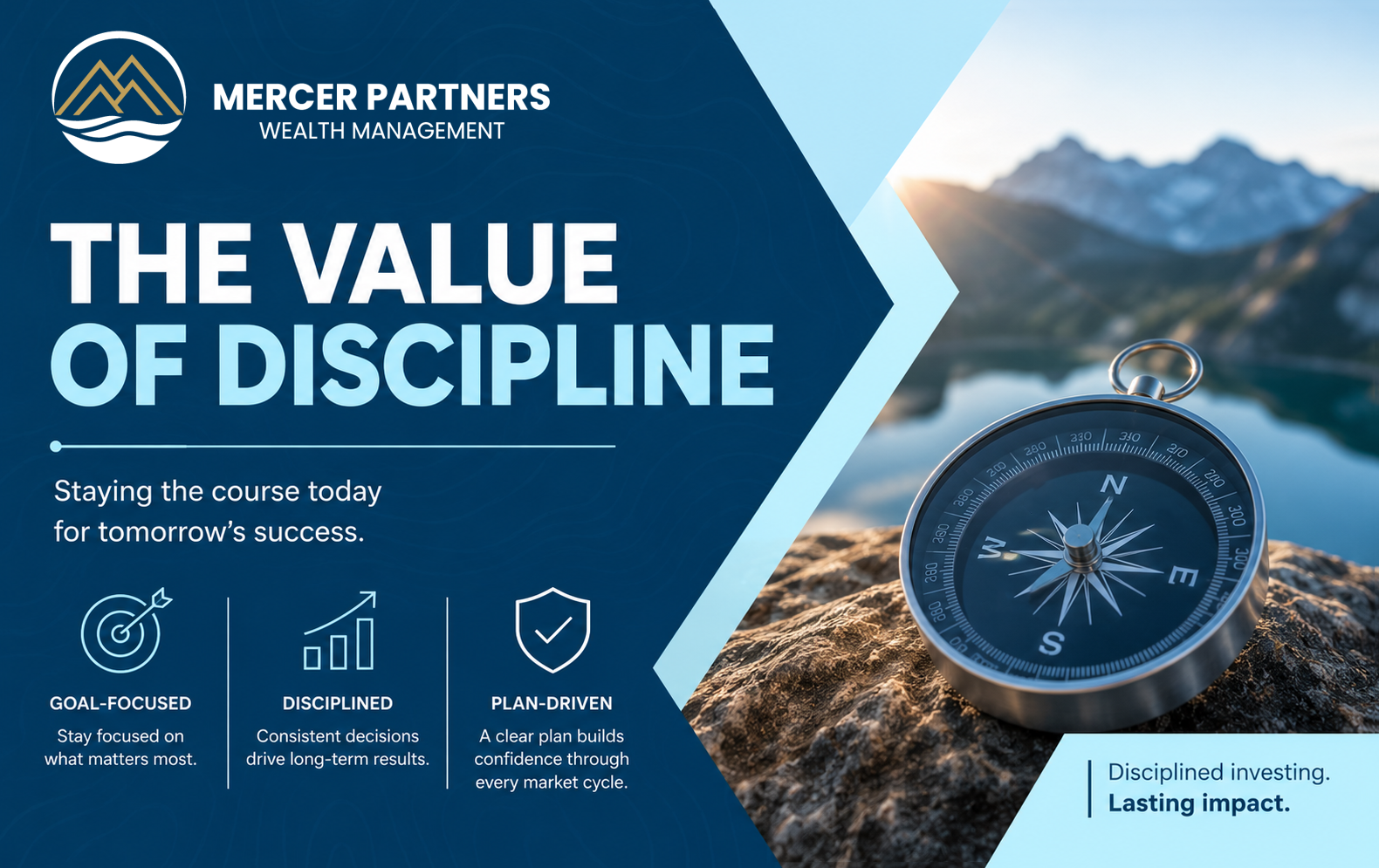
We are long-term, goal-focused, and plan-driven investors. Everything begins with a clearly defined financial plan — your roadmap — and your portfolio exists to serve that plan, not the other way around.
We invest primarily in broadly diversified portfolios of high-quality equities because we believe ownership in great businesses is the most reliable way to grow wealth over time and outpace inflation.
We do not believe that the economy can be consistently forecast, nor that markets can be reliably timed. History shows no dependable pattern in how markets respond to economic developments — sometimes they react, sometimes they ignore them entirely.
From this, we draw an important conclusion: the only realistic way to capture the long-term return premium of equities is to endure their inevitable periods of volatility. Market declines are frequent, sometimes uncomfortable, but they have historically been temporary in the context of long-term investing.
As a result, we do not react to — or attempt to anticipate — short-term economic or market events. When your long-term goals remain unchanged, so does our plan. And when the plan stays intact, so does your investment strategy, aside from disciplined rebalancing.
We believe deeply in the power of long-term compounding. To borrow wisdom from the late Charlie Munger: “The first rule of compounding is never to interrupt it unnecessarily.” Much of successful investing is simply avoiding the temptation to get in our own way.
Perspective on the Current Environment
In 2025, the broad U.S. equity market delivered its third consecutive year of double-digit returns, supported by a resilient economy and strong growth in corporate earnings. The S&P 500 finished the year up 16.4%, rewarding disciplined investors who stayed the course.
Looking ahead, analysts broadly expect earnings growth to remain robust, with projections approaching 15% annually in both 2026 and 2027 (source: Yardeni Research). While forecasts are never guarantees, earnings growth has historically been the most durable driver of long-term market returns.
Somewhat remarkably, corporate profit margins have continued to expand — reaching approximately 13.1% in the third quarter of 2025, the highest level in more than 15 years (source: FactSet). Many expected rising costs and consumer resistance to pricing increases to pressure margins. So far, that concern has not materialized.
The most visible area of softness has been the labor market, where conditions have cooled modestly. Yet even here, there is an important silver lining. Strong economic output alongside a flatter employment picture has led to meaningful gains in productivity. While unemployment recently ticked up to roughly 4.7%, most of the workforce is producing more per hour — enabling companies to raise wages without fueling inflation.
Monetary policy has also become more supportive. After six rate cuts, Federal Reserve policy is now approximately 175 basis points looser than it was a year ago. Historically, the effects of monetary easing tend to show up with a lag, which could provide an additional tailwind as we move through 2026.
Meanwhile, many households — particularly in the middle class — are expected to benefit from sizable tax refunds this filing season, estimated around $150 billion in total. Key drivers include a higher standard deduction and a temporary expansion of the SALT deduction cap. Putting it all together, these factors could provide a modest but meaningful boost to economic activity.
It would not surprise me if much of this constructive data feels unfamiliar. Financial news coverage naturally skews negative — not because things are always bad, but because fear commands attention. This makes perspective not just helpful, but essential.
Staying Focused When the Noise Gets Loud
Markets, of course, are forward-looking. A strong market may already reflect much of the good news — and perhaps some optimism about what lies ahead. That’s why the “burning question” is always changing. Last year it was, “Are we in an AI bubble?” Before that, it was, “When will the Fed cut rates?” Before that, “Is a recession coming?”
There was no recession — but that misses the point. The real lesson is that the question dominating headlines is usually the wrong one for long-term investors like us. It distracts far more than it informs.
It’s true that today’s market is more concentrated in a handful of very large technology companies than at any point in our investing lifetimes. It’s also true that valuations are elevated relative to long-term averages.
My response is twofold: first, valuation has never been — and never will be — a reliable market-timing tool. Second, disciplined portfolio rebalancing is precisely how we manage concentration risk over time.
History suggests that the next major market shock — and there will always be another — will likely come from an unexpected direction. When it does, it will have little relevance to our long-term plan, except perhaps as an opportunity to rebalance and invest at more attractive prices.
We follow a strategy that has worked over decades by helping investors pursue their goals. We do not subscribe to the idea that “this time is different,” regardless of what “this” happens to be. We don’t abandon our plan during periods of fear, and we don’t chase “new era” promises during periods of excitement.
Faith, patience, and discipline remain our greatest advantages (emphasis added).
Looking Ahead
As we move into 2026, I am genuinely optimistic — not because the future will be free of uncertainty, but because we are prepared for it. You have a plan. Your investment portfolio is built to support that plan. And we will continue to guide you thoughtfully through whatever lies ahead.
Thank you for your continued trust and confidence. Whether you’ve been with us for many years or have recently joined our community, please know how much we value our relationship with you. As always, I’m here to answer questions, provide clarity, and help you stay focused on what truly matters.
I wish you and your family a very healthy, happy, and prosperous year ahead.
Best,
Nick
The opinions voiced in this material are for general information only and are not intended to provide specific advice or recommendations for any individual. All performance referenced is historical and is no guarantee of future results. All indices are unmanaged and may not be invested into directly.
There is no guarantee that a diversified portfolio will enhance overall returns or outperform a non-diversified portfolio. Diversification does not protect against market risk.
Rebalancing a portfolio may cause investors to incur tax liabilities and/or transaction costs and does not assure a profit or protect against a loss.
Economic forecasts set forth may not develop as predicted and there can be no guarantee that strategies promoted will be successful.
Securities offered through LPL Financial. Member FINRA/SIPC. Investment advice offered through Private Advisor Group, a registered investment advisor. Mercer Partners Wealth Management and Private Advisor Group are separate entities from LPL Financial.